What Time Period Date andor Art Period Did Charles Demuth
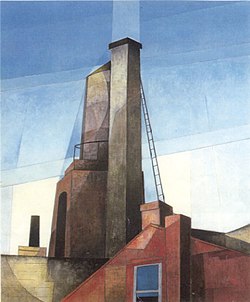
Precisionism was the outset indigenous modern art motility in the United states of america and an early on American contribution to the rise of Modernism. The Precisionist manner, which get-go emerged afterwards Earth War I and was at the summit of its popularity during the 1920s and early 1930s, historic the new American landscape of skyscrapers, bridges, and factories in a form that has besides been called "Cubist-Realism."[1] The term "Precisionism" was kickoff coined in the mid-1920s, perhaps past Museum of Modern Art managing director Alfred H. Barr[2] although according to Amy Dempsey the term "Precisionism" was coined by Charles Sheeler.[3] Painters working in this style were also known every bit the "Immaculates", which was the more than usually used term at the time.[4] The stiffness of both fine art-historical labels suggests the difficulties gimmicky critics had in attempting to narrate these artists.
An American movement [edit]
Influenced by Cubism and Futurism, Precisionism took for its primary themes industrialisation and the modernization of the American landscape, the structures of which were depicted in precise, sharply divers geometrical forms. Precisionist artists considered themselves strictly American and some were reluctant to acknowledge their European creative influences.[5] Still it was readily credible at the time that the fracturing of planes in many Precisionist paintings originates in the Cubism of Picasso and Léger; similarly, Precisionist renderings of shafts of low-cal equally rigidly drawn "lines of forcefulness" is a clear borrowing from Futurism. In the end, Precisionism was less about pure originality of expression and more nearly an energetic American use and amalgamation of certain European modernist techniques. Function of precisionism's originality is constitute in its subject area matter and outlook.
There is a degree of reverence for the industrial age in the movement, but social commentary was not fundamental to the style. Like Pop Art, Precisionism has on occasion been interpreted as a criticism of the de-natured society it portrays, though its artists did not often feel comfortable with this reading of their work. Elsie Driggs' Pittsburgh (1926) illustrates this gap in perception.[6] A painting of black and grayness steel-factory smokestacks, thick pipe, and crisscrossing wires, with but clouds of smoke to relieve the severity of the image, viewers have been tempted to encounter this dark painting as a argument of ecology business concern. To the contrary, Driggs always claimed that she intended an ironic beauty in the prototype and referred to it as "my El Greco." Upon seeing the painting, Charles Daniel dubbed her "one of the new classicists."[7] More often than non, Precisionism implicitly celebrated man-made dynamism and new technologies. Possible exceptions to this argument are some of the darker, more claustrophobic city paintings of Louis Lozowick and the comic anti-capitalist satires of Preston Dickinson.
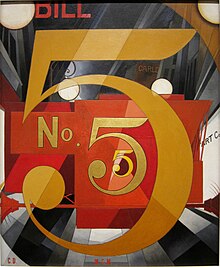
As might be expected, varying degrees of abstraction are found in Precisionist works. The Figure five in Gold (1928) by Charles Demuth, a clamorous hommage to William Carlos Williams' imagist poem about a fire truck is abstract and stylized, while the paintings of Charles Sheeler sometimes verge on a form of photorealism. (In addition to his meticulously detailed paintings similar River Rouge Plant and American Landscape, Sheeler, like his friend Paul Strand, also created sharply focused photographs of factories and public buildings.[8]) The majority of Precisionist paintings and drawings, however, present no obstacles in identifying their imagery. Some Precisionist work tended toward a "highly controlled arroyo to technique and class" as well as an application of "hard-edged style to long-familiar American scenes".[9] Precisionist artists aimed to convey the geometric and psychological essence of a scene or a structure but intended that essence to be almost immediately accessible.
Most Precisionist imagery is urban: office towers, apartment houses, bridges, tunnels, subway platforms, streets, the skyline and grid of the modern urban center. Other artists, still, such as Charles Demuth, Niles Spencer, Ralston Crawford, Sanford Ross, and Charles Sheeler, applied the aforementioned approach to more than pastoral settings and painted starkly geometric renderings of barns, cottages, country roads, and subcontract houses. Artists such as Stuart Davis and Gerald Murphy painted Precisionist nonetheless lifes besides.
Precisionists [edit]

Many American artists worked in a Precisionist manner over a twenty-year menstruum. George Ault, Ralston Crawford, Francis Criss, Stuart Davis, Charles Demuth, Preston Dickinson, Elsie Driggs, Louis Lozowick, Gerald Murphy, Charles Sheeler, Niles Spencer, Morton Schamberg and Joseph Stella, were among the virtually prominent Precisionists.[ten] Examples of their piece of work can exist found in most major American museum collections. Charles Rosen, Dale Nichols, Millard Sheets,[11] Virginia Berresford, Henry Billings, Peter Blume, Stefan Hirsch, Edmund Lewandowski, John Storrs, Miklos Suba, Sandor Bernath, Herman Body, Arnold Wiltz, Clarence Holbrook Carter, Edgar Corbridge and the photographers Paul Strand and Lewis Hine were other artists associated with Precisionism. The move had no major presence outside the United States, although it did influence Australian art where Jeffrey Smart adopted its principles. Although no manifesto was ever created, some of the artists were friends and ofttimes exhibited at the same galleries. Georgia O'Keeffe, specially with paintings like New York Urban center with Moon (1926) and The Shelton With Sun Spots (1926), created her own more sensuous version of Precisionism, although her best-known works are not closely related to Precisionism, and information technology would be inaccurate to land that O'Keeffe (who vehemently resisted motion ties) was closely aligned with the Precisionist movement. Her husband, photographer and fine art dealer Alfred Stieglitz, was a highly regarded mentor for the group and was peculiarly supportive of Paul Strand.
Precisionist art would have an indirect influence on the later styles known as magic realism, popular fine art, and photorealism, but it was largely considered a dated "period style" by the 1950s, though its influence on advertising imagery and stage and set blueprint continued throughout the twentieth century. Its two almost famous practitioners are Charles Demuth and Charles Sheeler.
Gallery [edit]


References [edit]
- ^ Milton Brown, American Painting from the Armory Show to the Depression (Princeton: Princeton University Printing, 1955), pp. 114–115.
- ^ Gail Stavitsky, Precisionism in America, 1915–1941: Reordering Reality (New York: Abrams, 1994), p. 21.
- ^ [Styles, schools and movements, published by Thames & Hudson 2002 Amy Dempsey]
- ^ Stavitsky, p. xix.
- ^ Metropolitan Museum of Fine art
- ^ For a fuller give-and-take of Pittsburgh, meet Constance Kimmerle, Elsie Driggs: The Quick and the Classical (Philadelphia: University of Pennsylvania Printing, 2008), pp. 31-33 and John Loughery, "Blending the Classical and the Modern: The Fine art of Elsie Driggs", Woman'southward Art Journal (Wintertime 1987), p 24.
- ^ Kimmerle, p. 32.
- ^ Charles Sheeler photo, retrieved online November ix, 2008
- ^ Metropolitan Museum of Art
- ^ The New York Times, Roberta Smith, ART VIEW: Precisionism And a Few Of Its Friends", October 26, 2008
- ^ The Hilbert Museum reveals treasures of California Scene Painting, Liz Goldner, February 24, 2016 KCET https://www.kcet.org/
Sources [edit]
- Friedman, Martin 50. The Precisionist View in American Art. Minneapolis: Walker Art Center, 1960.
- Harnsberger, R.S. Ten Precisionist Artists: Annotated Bibliographies. Art Reference Drove no. 14. Westport, CT: Greenwood Press, 1992.
- Hughes, Robert. American Visions: The Epic History of Art in America. New York; Knopf, 1994.
- Kimmerle, Constance. Elsie Driggs: The Quick and the Classical. Philadelphia: Academy of Pennsylvania Press, 2008.
- Stavitsky, Gail. Precisionism in America, 1915–1941: Reordering Reality. New York: Abrams, 1994.
- Tsujimoto, 1000. Images of America: Precisionist Painting and Modernistic Photography. Seattle: Academy of Washington Press, 1982.
Further reading [edit]
- Kramer, Hilton, 1982, "Precisionism Revised" in Revenge of the Philistines, Art & Civilisation 1972–1984. Costless Press, September 12, 2007, ISBN 1416576932
External links [edit]
- "Precisionism" in Artcyclopedia
- Precisionism at the Metropolitan Museum of Art
- Precisionists—Consummate Anti-Expressionists
Source: https://en.wikipedia.org/wiki/Precisionism
0 Response to "What Time Period Date andor Art Period Did Charles Demuth"
Enregistrer un commentaire