Where Is Judd a And Marjorie Weinberg College of Arts and Sciences
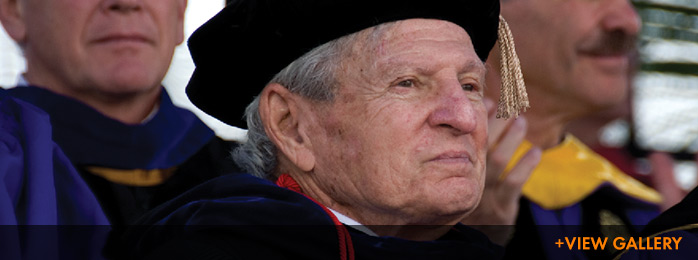
Judd Weinberg at Weinberg College'due south Convocation in June
Judd Weinberg: The Man Behind Our Name
Xiii years ago, Judd Weinberg and his family gave a remarkable gift to the College of Arts and Sciences at Northwestern. Their generosity was recognized with the naming of the College in their honor. The undergraduate educational experience has been enhanced in so many ways since then: the hiring of stellar kinesthesia across many fields; an invigorated advising organisation; the growth of the signature undergraduate programs for which the College is known; independent research opportunities; and partnerships with Chicago cultural and scientific institutions. In March, as his 85th birthday approached, Judd and his eldest son, David, agreed to sit down with Crosscurrents in their Loop office and share some of their stories. It is hoped that now, when a new generation of graduates sees that familiar name on their diplomas—The Judd A. and Marjorie Weinberg College of Arts and Sciences—they will know some of the history behind this extraordinary family and the sources of their loyalty to the Academy.
Wildcat Days in Wartime
Judd Weinberg, a graduate of Chicago'south Lakeview Loftier School, entered Northwestern in the fall of 1943, midway through U.Southward. interest in the Second Earth War. The Evanston campus had inverse dramatically to adjust the influx of war machine personnel, especially Navy men. Quonset huts had sprouted nearly Dyche Stadium (at present Ryan Field) to firm those enrolled in preparation programs. Science laboratories were being used for classified research.
"The Navy had taken over the fraternity houses, and the male students had to rent rooms in nearby private homes," Judd recalled. "I lived on Orrington Artery."
He wished to serve his country but was classified 4-F due to a knee injury, and so he stayed on campus and pursued other opportunities for leadership. He was president of the social fraternity Phi Epsilon Pi and was the first Jewish student to be elected president of the Interfraternity Council. He was co-chairman of the almanac May Sing, although he remembered with a chuckle that others, noting his lack of singing ability, asked him to merely mouth the words of the schoolhouse songs. As the war ended, Dean of Students F. George Seulberger asked him to head a group to welcome fraternity men back to campus. There was hazing in fraternities at the time.
"Men coming habitation from the war were used to defending themselves," explained the elderberry Weinberg. "I didn't call back that hazing them was a good idea, so we decided to do away with it."
Judd was a business major whose career goal, mirroring that of many of the Greatest Generation, was "to make a living." But some of his fondest memories concern sociology professor William F. Byron, a popular teacher and a noted activist for peace and social justice.
"He was just fabled; he had been Jane Addams's secretary at Hull Firm," said Judd. "He told me there was a church building a few blocks south of Howard Street where they needed someone to run an after-school program for 10-year-former boys who had never been anywhere. Two days a week, I ran an subsequently-school program for them, and on Saturdays I took six or 7 of them in my Chevy to the Field Museum, to the Shedd Aquarium, to the Lincoln Park Conservatory. I got even more out of it than they did."
Judd and his higher friends liked to frequent Evanston's Toddle House diner, which was on the honor system: y'all paid for your waffles, hash browns or MasterBurgers by leaving coin in a container by the door. He also played span in the basement of Scott Hall, sometimes all night long because men were free to do so, even in those days.
The lasting lessons he carried forth from Northwestern concerned social skills, he said: how to get forth with people, how to be a leader. These skills would serve him well in his concern career as an innovator and motivator of people.
Meeting Marjorie
Although Marjorie Gottlieb attended Northwestern (she was a first-yr student when he was a senior), Judd didn't meet her until after he had graduated. Then it was love at first sight. After their first date, he tried to be patient and waited all of ix days to propose to her. They were married in 1950; together they raised 3 sons in the Chicago suburbs, beginning in Oak Park and afterward in Winnetka.
David described his female parent with pride: "She was extraordinary—intellectually curious, determined, and organized. She was potent with the kind of strength that'south borne out of religious faith." She created a women's auxiliary for Gottlieb Memorial Hospital in Melrose Park, which had been founded by her parents in 1960. Showing health sensibilities alee of her time, she refused to let the hospital souvenir shop sell cigarettes.
"She never merely lent her name to a cause," said David. "She showed upwardly and did the work. Non agape to be a pioneer, she was oftentimes the outset Jewish adult female in an organization. She ever welcomed it as a claiming.
"She fought lymphoma for xi years, with my begetter at her side, and died at the age of 64," said David. "She lived to see all her children married and the nascency of all of her grandchildren." In improver to her family, her legacy was her devotion to the hospital, to Wisdom Bridge Theatre, to the Lincoln Academy of Illinois, and to Northwestern.
Launching a Career
Both Judd's and Marjorie'south fathers had started their own companies. Judd's male parent, Jack Weinberg, along with his brother, founded Oxxford Clothes, a Chicago manufacturer of finely tailored menswear, in 1916. After college, Judd worked in the business until 1952. Another kind of opportunity awaited him. "At Oxxford, I was the within person running the shop when I wanted to be in sales. In life you need luck; you need to be in the right place at the right time in history."
The right place for Judd was D. Gottlieb & Co., founded by Marjorie's father in 1927. The firm was a leader in the cut-edge game technology of the day: not-gambling pinball machines. In 1931, Gottlieb'southward Baffle Brawl became the first big hitting of coin-operated games, with a depression-era public eager for inexpensive amusement.
"My father-in-police was a groovy entrepreneur," said Judd. "He introduced electricity to the games, and bumpers, and scoring." The visitor'south 1947 development of 2-inch bats called "flippers" revolutionized the industry, giving players the ability to shoot the ball dorsum up the playfield and win more points. Gottlieb pinball machines of the mail service-war era are now considered collectors' items.
Judd'due south contribution, in the 1950s and '60s, was to globalize the business. He initially went to New York to meet exporters with European connections. He had no luck. And then a businessman from French republic chosen him and the tide began to turn. It seems the man had been a hero during the French Resistance and was able to assistance influence the government to contrary a police force which banned pinball games in French republic. Sales grew especially strong non only in France, just in Italy, the Great britain, Germany and Nihon.
"America was popular after Globe War Two," said Judd. "So on the top of every pinball automobile, we wrote 'every bit American every bit baseball game and hot dogs.'" He remembers existence awake often, in the pre-dawn hours, to conduct business by phone on European time. With his leadership, the business organization grew tenfold.
"My male parent was a wonderful boss," said David. "Under his watch, the talented staff blossomed."
Judd attributes his success to "working difficult and being fortunate, being surrounded past able people. Nobody does this on their own."
In 1976, Judd sold the visitor to Columbia Pictures Entertainment, Inc. He became a consultant to the movie company and a member of its board of directors. He is currently chairman of the executive commission of the fiscal services house he founded, Judd Enterprises.
His sons accept enjoyed successful careers of their own. Afterwards a xx-yr legal career, David is chairman and CEO of Judd Enterprises. David too is vice chair of the board of trustees of Northwestern, a director of the Terra Foundation for American Art, and former chairman of the Board of the Ravinia Festival Association.
In improver to being president of the family business firm, Richard is a Broadway producer and has served on a number of professional and philanthropic boards, including The American Jewish Committee, the The statesC. School of Theatre, the Sundance Institute, and Savoy Pictures Entertainment, Inc.
Jack founded, operated, and sold a video postal service-product company and is now a existent estate investor. He serves as chairman of the board of the Gottlieb Memorial Foundation, a director of Loyola Academy Health Systems, a commissioner of the Glencoe Park Commune, and formerly served as a director of the Hockey Association of Illinois.
Giving, And then and At present
Weinberg generosity is deeply rooted in family history. David Weinberg related a story about his maternal granddad, David Gottlieb, whose ain father was a tailor. Coin was deficient, then everyone pitched in. Gottlieb recalled that his older brother proudly emptied his pockets at the end of a workday, leaving his earnings for his family on the kitchen tabular array. David Gottlieb said that this experience led him to become philanthropic at an early age and to laissez passer on these values to his family.
Judd told of his begetter Jack'south adolescence. "His ain begetter had died when he was vi months quondam; Jack'due south mother Jennie became a peddler who carried her wares in a pack on her back. They lived in one room and Jennie stoked the fire every morning so their dress would thaw out." Jack was able to nourish the Jewish Grooming School on Chicago'southward West Side, a school founded by before descendants of immigrants. With the skills obtained there and in subsequent jobs, Jack and his brother later founded Oxxford Clothes.
David reiterated his sentiments voiced at the fourth dimension of the Weinberg naming gift. "Like most citizens of this state, we are the descendants of immigrants. We are grateful beyond words for the difficult-earned blessings of liberty afforded to the states. This gift is 1 expression of our gratitude for those blessings."
The Weinberg family has given generously to Northwestern in other ways and continues to do so. Judd is a Life Trustee of the Academy. Both he and David are members of the Higher's Board of Visitors. A gift to the medical schoolhouse established the Weinberg Medical Informatics Preparation Center. The family has also supported the School of Advice, the Donald P. Jacobs Chair at the Kellogg School of Direction, and the Arnold R. and Edna F. Weber Scholarship Fund. Recently, Judd's three sons dedicated the Marjorie Weinberg Garden, a beautifully landscaped spot on the south side of Deering Meadow, in their mother's honour. In addition, they have funded a new endowed chair, the Weinberg Family Distinguished Professorship of Life Sciences.
"It'south an honor to be part of Northwestern," said David, "an institution that makes such a great difference in the world. Nosotros believe very deeply in both the discovery of new noesis as a manner for our civilization to advance, and in the transmission of that cognition to our brightest young minds, enabling them to become forward and forge a but and sustainable world."
Back to topSource: https://weinberg.northwestern.edu/after-graduation/weinberg-magazine/crosscurrents-archive/2011-spring-summer/judd-weinberg.html
0 Response to "Where Is Judd a And Marjorie Weinberg College of Arts and Sciences"
Enregistrer un commentaire